Tuesday, April 24, 2007
Land Use, Veggies, Food, and Farm Subsidies
THM pointed out this article in the New York Times Magazine by Michael Pollan. Pollan is the author of The Omnivore's Dilemma (in addition to lots of other things), and this article is on a similar topic. The article is primarily about the economy of nutrition and the effects that the farm bill has on the price and production of food. At it's heart this is also a land use issue, and therefore appropriate for posting on an earth science blog. I'll do a proper review of The Omnivore's Dilemma at some point in the future, but as for now you'll have to settle for the links.


Monday, April 23, 2007
Apparent Dip Music Club Update - David Francey Concert
I took advantage today of a repetitive lab procedure to reserve a ticket for my first concert in a long time, and the first since I made it to the northeast. This Sunday David Francey is playing in a nearby town (not much of a drive at all), and Thermochronic has a ticket! I blogged about David Francey when I first started Apparent Dip, I even embedded some YouTube videos of him performing. Unfortunately the videos are no longer available on YouTube, but for just $15.00 I'll be able to see him live. This will of course lead to the first Apparent Dip concert review, but that's it for now. I post this mainly because I am excited, but also to point out that David Francey has a pretty extensive tour he is in the middle of, so if he is coming to a little opera house a short drive from you, my bet is that it will be well worth the travel.
Sunday, April 22, 2007
The Age Equation
This post is inspired by some emails I've received as well as a good group of google searches that have pointed folks to Apparent Dip. The Age Equation is central to geochronology, and forms the basis for age calculations. It is actually fairly simple to derive, so here we go
In the following derivation, N is the number of radioactive parent atoms at time t, N0 is the original number of radioactive parent atoms, D is the number of stable daughter atoms, λ is the decay constant, and t½ is the half life of a radioactive atom. The situation I use as an example is one parent and one stable daughter. Slight modifications are needed for multiple parents (the (U-Th)/He system), multiple daughters (40K decay), or the use of unstable daughters in a decay chain (U-series dating).
The activity, or rate of decay of a radioactive isotope is proportional to the number of radioactive atoms present

By introducing a proportionality constant λ (which we will call the decay constant), we can turn the above equation into

Because the λ is in units time-1, and the number of atoms decreases with time, we also throw in a negative sign. Rearrange this equation

and integrate from N0 (original number of radioactive parent atoms) and t=0 (time zero)
 and we get

since t0 = 0, this leads to

which can be rearranged to


The above equation describes the number of radioactive atoms left after time t. The decay constants, along with their uncertainties, are readily available (I'll list some of the geologically important ones at the end of this post). Decay constants are inherent properties of the nucleus that describe the probability that an atom will decay. I blogged about demonstrating this phenomenon with M&M's here
OK, so the above equation is handy, but when we work with geologic samples, we don't know N0, the original number of parent atoms in the crystal, so can we put this equation into terms of things we can measure today?
In a system with one parent and one daughter, N0 is the sum of N, the number of parents left, and D, the number of daughters produced.

So if we put the last two equations together, we get this

Which is entirely in terms of things we can measure in the lab. The next steps are simple mathematical rearrangements


Until we get an equation that solves for time and whose variables are all things that we can measure.

I've been using the decay constant up until now, which as I said earlier describes the probability that an atom will decay. The half-life of an isotope is a more intuitive measure, the half-life is a unit of time over which half of the radioactive atoms in a given population will decay. You can easily see the relationship between the decay constant (λ) and half-life (t½) with this simple exercise. At t½, half of the parents have decayed and turned into daughters, so N=D, and D/N = 1. So let's plug that into our age equations

and we get the relationship between λ and t½

So the equations are pretty straightforward. As I said, they get a bit more complicated for more complicated decay schemes, but the basics are all the same.
Here are some of the more important radioactive isotopes, decay constants, and half lives. I got this information from table 1.1 of Alan Dickin's Radiogenic Isotope Geology (2ed), he has the references for the appropriate scientific papers listed as well.
And, as usual Ga means billion years, and Ma is million years. Now you too can enjoy hittin' the geochronic.
In the following derivation, N is the number of radioactive parent atoms at time t, N0 is the original number of radioactive parent atoms, D is the number of stable daughter atoms, λ is the decay constant, and t½ is the half life of a radioactive atom. The situation I use as an example is one parent and one stable daughter. Slight modifications are needed for multiple parents (the (U-Th)/He system), multiple daughters (40K decay), or the use of unstable daughters in a decay chain (U-series dating).
The activity, or rate of decay of a radioactive isotope is proportional to the number of radioactive atoms present

By introducing a proportionality constant λ (which we will call the decay constant), we can turn the above equation into

Because the λ is in units time-1, and the number of atoms decreases with time, we also throw in a negative sign. Rearrange this equation

and integrate from N0 (original number of radioactive parent atoms) and t=0 (time zero)
 and we get
since t0 = 0, this leads to

which can be rearranged to


The above equation describes the number of radioactive atoms left after time t. The decay constants, along with their uncertainties, are readily available (I'll list some of the geologically important ones at the end of this post). Decay constants are inherent properties of the nucleus that describe the probability that an atom will decay. I blogged about demonstrating this phenomenon with M&M's here
OK, so the above equation is handy, but when we work with geologic samples, we don't know N0, the original number of parent atoms in the crystal, so can we put this equation into terms of things we can measure today?
In a system with one parent and one daughter, N0 is the sum of N, the number of parents left, and D, the number of daughters produced.

So if we put the last two equations together, we get this

Which is entirely in terms of things we can measure in the lab. The next steps are simple mathematical rearrangements


Until we get an equation that solves for time and whose variables are all things that we can measure.

I've been using the decay constant up until now, which as I said earlier describes the probability that an atom will decay. The half-life of an isotope is a more intuitive measure, the half-life is a unit of time over which half of the radioactive atoms in a given population will decay. You can easily see the relationship between the decay constant (λ) and half-life (t½) with this simple exercise. At t½, half of the parents have decayed and turned into daughters, so N=D, and D/N = 1. So let's plug that into our age equations

and we get the relationship between λ and t½

So the equations are pretty straightforward. As I said, they get a bit more complicated for more complicated decay schemes, but the basics are all the same.
Here are some of the more important radioactive isotopes, decay constants, and half lives. I got this information from table 1.1 of Alan Dickin's Radiogenic Isotope Geology (2ed), he has the references for the appropriate scientific papers listed as well.
| Isotope | Decay Constant (yr-1) | Half-Life |
| 40K (40Ar) | 5.81 X 10⁻¹¹ | 11.93 Ga |
| 40K (40Ca) | 4.962 X 10⁻¹⁰ | 1.397 Ga |
| 40K (total) | 5.543 X 10⁻¹⁰ | 1.25 Ga |
| 235U | 9.8485 X 10⁻¹⁰ | 703.8 Ma |
| 238U | 1.55125 X 10⁻¹⁰ | 4.468 Ga |
| 232Th | 4.9475 X 10⁻¹¹ | 14.01 Ga |
| 87Rb | 1.402 X 10⁻¹¹ | 49.44 Ga |
| 147Sm | 6.54 X 10⁻¹² | 106 Ga |
| 176Lu | 1.86 X 10⁻¹¹ | 37.3 Ga |
And, as usual Ga means billion years, and Ma is million years. Now you too can enjoy hittin' the geochronic.
Tuesday, April 17, 2007
NCSE Web Resources
The National Center for Science Education is now offering free access to a variety of digital resources dealing with recent evolution related trials and general evolution and science promotion. I haven't checked out the files myself [yet] but the NCSE has a good track record, so I thought that shouldn't stop me from advertising.
To see the archives click here.
To see the archives click here.
Springtime at ESRU
Mild, sunshiny days, chirping birds, bright flowers...Spring is such a magical time of year, even here at ESRU. I thought I'd share some pictures I took yesterday morning.


Odd weather abounds in my first year in the northeast, we had more snow on easter than we did on christmas, and now weeks past opening day I am wishing I hadn't taken off my snow tires.


Odd weather abounds in my first year in the northeast, we had more snow on easter than we did on christmas, and now weeks past opening day I am wishing I hadn't taken off my snow tires.
Thursday, April 12, 2007
Wunderground and free public data
The following post may seem like I am meandering but there is a point, I promise, stay with me.
We in the American northeast have been enjoying a pretty late winter this year, meaning, it's a hell of a lot colder than April is supposed to be. The place I used to live was, in general, much warmer, and I got to thinking of the temperature difference between where I used to live. This got me hitting Wunderground, a weather site I started checking thanks to my Mom (an amateur weather guru who often knows more about my weather from 3000 miles away than I do). One of the cool things about Wunderground is that they make it easy to download historical weather data. For example, after about 10 minutes of clicking and Excelling I made this
 Which shows the temperature difference between where I lived in grad school and where I live now. The y-axis is the difference in average daily temperature (°F) between old home and new home; values above 0 mean it is warmer at BWRU, and values below 0 mean it is warmer here at ESRU. The line is a five day running average. Why 5 days? I have no idea, but I'd appreciate a good reason if anyone can think of one. There are a couple things I noticed after putting this together. First, we had a really warm winter here at ESRU, until well into January it really wasn't much warmer back at BWRU. Second, there is an odd apparent periodicity in the running average, with a fortnightly recurrence. You can sum up my statistical analysis of this feature with the words "Jack Squat," but it is still potentially interesting. The maximum difference was just a month ago, March 6th when it was 59° colder here than there.
OK, great, it is colder in the northeast than a western school at a lower latitude, big shocker. Doing this though reminded me of an exercise I came up with when teaching an earth hazards course in 2004, again using Wunderground. In February of 2004 there was flash flooding in the southern part of San Francisco. Pretty exciting, there was water rushing down stairwells and elevator shafts at San Francisco State University. At this time I was teaching this earth hazards course at an area school, so I used Wunderground to come up with this homework. I had the students get the rainfall data for two days from the same station, the flash flood day (2/25/2004) and another day, a few months earlier that had some serious rainfall but resulted in no flash flooding (12/29/2003). This is the graph they were supposed to come up with

The y-axis is rainfall rate (in inches per hour), and the x-axis is time. The total rainfall for both days was actually remarkably similar, actually 12/29 had more cumulative rainfall, but the flash flood day had all that rain packed into less than an hour, instead of spread out over the day. Basically I was driving home the point that flash floods, unlike regional floods, come from large amounts of rain in small amounts of time.
What both of these exercises got me thinking about is free public data sets. Wunderground does not provide the kind of really rigorous data I'd use if I was working on an actual publishable study, but as a teaching tool or means of illustrating basic earth science concepts, it is fantastic. So Wunderground is great for relatively recent weather data. What about other public earth science related data repositories?
We in the American northeast have been enjoying a pretty late winter this year, meaning, it's a hell of a lot colder than April is supposed to be. The place I used to live was, in general, much warmer, and I got to thinking of the temperature difference between where I used to live. This got me hitting Wunderground, a weather site I started checking thanks to my Mom (an amateur weather guru who often knows more about my weather from 3000 miles away than I do). One of the cool things about Wunderground is that they make it easy to download historical weather data. For example, after about 10 minutes of clicking and Excelling I made this
 Which shows the temperature difference between where I lived in grad school and where I live now. The y-axis is the difference in average daily temperature (°F) between old home and new home; values above 0 mean it is warmer at BWRU, and values below 0 mean it is warmer here at ESRU. The line is a five day running average. Why 5 days? I have no idea, but I'd appreciate a good reason if anyone can think of one. There are a couple things I noticed after putting this together. First, we had a really warm winter here at ESRU, until well into January it really wasn't much warmer back at BWRU. Second, there is an odd apparent periodicity in the running average, with a fortnightly recurrence. You can sum up my statistical analysis of this feature with the words "Jack Squat," but it is still potentially interesting. The maximum difference was just a month ago, March 6th when it was 59° colder here than there.
OK, great, it is colder in the northeast than a western school at a lower latitude, big shocker. Doing this though reminded me of an exercise I came up with when teaching an earth hazards course in 2004, again using Wunderground. In February of 2004 there was flash flooding in the southern part of San Francisco. Pretty exciting, there was water rushing down stairwells and elevator shafts at San Francisco State University. At this time I was teaching this earth hazards course at an area school, so I used Wunderground to come up with this homework. I had the students get the rainfall data for two days from the same station, the flash flood day (2/25/2004) and another day, a few months earlier that had some serious rainfall but resulted in no flash flooding (12/29/2003). This is the graph they were supposed to come up with

The y-axis is rainfall rate (in inches per hour), and the x-axis is time. The total rainfall for both days was actually remarkably similar, actually 12/29 had more cumulative rainfall, but the flash flood day had all that rain packed into less than an hour, instead of spread out over the day. Basically I was driving home the point that flash floods, unlike regional floods, come from large amounts of rain in small amounts of time.
What both of these exercises got me thinking about is free public data sets. Wunderground does not provide the kind of really rigorous data I'd use if I was working on an actual publishable study, but as a teaching tool or means of illustrating basic earth science concepts, it is fantastic. So Wunderground is great for relatively recent weather data. What about other public earth science related data repositories?
And So It Goes, R.I.P Kurt Vonnegut
Author Kurt Vonnegut died last night at the age of 84. In memorium and related to my last post, the following quote can easily be adapted to our discussion of reviews of scientific papers
Any reviewer who expresses rage and loathing for a novel is preposterous. He or she is like a person who has put on full armor and attacked a hot fudge sundae.
Kurt Vonnegut (1922-2007)
Wednesday, April 11, 2007
More on Reviews
Recently Lab Lemming started a good discussion on some of the issues involved with scientific reviews, specifically reviewer anonymity. This, and related posts throughout the geoblogosphere were especially timely for me. In the past two weeks I have reached two milestones in my scientific career. First, I wrote and submitted my first official review of a paper submitted to an honest to god reputable scientific journal. I was pretty excited about this to begin with. I have heard many of my bosses and older sciencey folk talk in exasperated tones about all of the papers they have to review and what a pain it was. I suppose after I've done this a hundred times I'll be sick of it, but for now it made me feel like a real professional geologist person. Anyways, I spent a lot of time on this review, wrote and re-wrote my comments, slept on it, read the paper a fourth time, and finally sent in the final comments. In general I was positive in my review, although I did raise some excellent points, which I hope to be thanked for generously in the acknowledgements paragraph of the final paper. How will I be thanked? Well, as an anonymous reviewer of course. This was a tough call for me. Theoretically I do not like anonymous reviews. I stand behind my comments and evaulation, so why don't I attach my name to them? I wasn't overly harsh or negative, and I even pointed out lots of good things. But why do I still fear retribution because I recommended acceptance only with revisions? Truth is, I think as a post-doc who will in the not too distant future be on the job market, I am not sure how much I want to risk souring potential search committee member's opinions of me. I do not yet have the position or name recognition to feel insulated at all from negative vibes. Even though I know I gave a fair and honest assessment, I left my name off the final review. Maybe Thermochronic is just a big old chicken?
And, let's add smarmy hypocrite to big old chicken, because I have also spent the past week grumbling about the second milestone of the past two weeks that I have achieved, namely getting an off-the-mark and anonymous negative review of a paper. This is not a paper I am first author on, but that has not stopped me from cursing anonymous reviewer #n under my breath. I don't know if anonymity played much of a role in making this review crappy, but I would at least like the name of a geologist to google and curse at while I take breaks from revisions. What kills me about this review is that (1) all of the other reviews were very positive, and (2) the comments actually didn't raise any significant issues, just the reviewer's unfamiliarity with some of our standard laboratory techniques.
I like the suggestion of Lab Lemming to include signed copies of reviews with tenure packages. I actually think we could take this a little farther and make reviewer anonymity temporary. If a paper gets published, and a year later the names of the reviewers are made available, then as long as the reviews were honest I think many of the fears of pay-back would be gone. Right now I am all hopped up, stomping around when I think of anonymous reviewer #n and his/her goofy comments, but when the paper is published, a year from now, the emotion of the rejection would be largely gone, and I'd be able to see the review in a much clearer light. Come to think of it, as I sit at the "Scientific Paper of the Year" awards banquet with my co-authors we will probably laugh about the whole incident. So, how's that, a statute of limitations on reviewer anonymity.
Friday, April 06, 2007
EOS and Wikipedia #2
For a follow up to my previous post, I'd just like to redirect you all to Ron Schott's Geology Home Companion Blog and this post. Ron has obviously thought a lot more about using the web as a geoscience resource than I have, and he brings up a lot of very good points on the matter. He also talks about the GeoWiki project he is spearheading, which is something we geoblogospherons (my new name for members of the geoblogosphere, which also sounds like a sub atomic particle) should become involved with.
Wednesday, April 04, 2007
EOS and Wikipedia
In a [relatively] recent issue of EOS (v.88, n.11, p.134-135), Mark Moldwin et al. discuss the popularity of Wikipedia as a source for undergraduate research in science classes. According to their informal survey, for most of the 300 surveyed students, Wikipedia was the first stop for them during their research process. The authors then briefly discuss the quality of information available on Wikipedia for their areas of interest, and end with a call for other specialists to do the same. I have never been a fan of internet "research", it seems to always end up with crappy papers rich with downloaded figures and light on critical thinking. But, I am also aware of the present reality, that when you start a research project outside of your area of specialization, the internet is the first place you go. Seriously, if I want to figure out who all of the people Stan Rogers sings about in "Northwest Passage" are, I am going to google it, or check out Wikipedia's page on the topic. If I want to go in depth, sure, then I head to the library and/or bookstore, but the internet, or more specifically Wikipedia, does perform an important role as a starting point. Seeing as how this is the present state of affairs, it is important that the information is at least correct. I spent some time last night looking at the wiki pages for my areas of specialty, and I must say I am unimpressed. They aren't really wrong, just incomplete, outdated, and rather uninspiring. So, I have decided that over the next few months I'll be adding to and updating the pages that I know the most about. I think this would be a worthwhile endeavor for the geoblogosphere. Many of us have written posts that deal with basic earth science concepts (see my sidebar), and between us all we could probably square away significant wiki real estate. So, take a look at a few pages and let me know what you think. This is in no way an endorsement of internet based papers. Students who turn them in should get low grades and reprimands, end of story. Peer review is too important of a concept in science to be replaced by anything, even google, and students need to know that. We should use wikipedia as a way to point people in the right direction, that's it.
Incidentally, this fits well with my current situation, I've been working on a post about K-Ar and Ar/Ar thermochronology for a while, but have yet to be happy with it. Perhaps it can serve double duty.
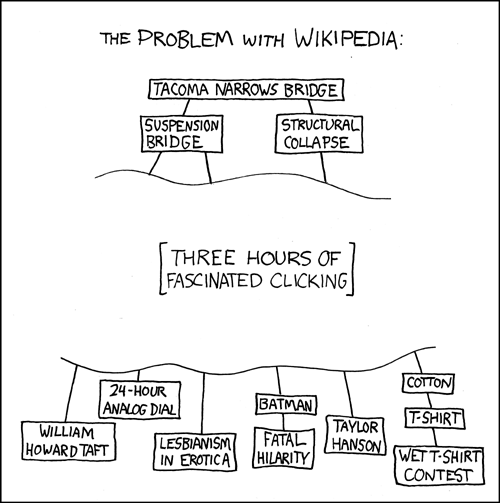
Disclaimer : Apparent Dip is not responsible if you have a debilitating attack of wikipeditis, the common affliction so perfectly illustrated by xkcd.

Incidentally, this fits well with my current situation, I've been working on a post about K-Ar and Ar/Ar thermochronology for a while, but have yet to be happy with it. Perhaps it can serve double duty.
Disclaimer : Apparent Dip is not responsible if you have a debilitating attack of wikipeditis, the common affliction so perfectly illustrated by xkcd.
Wednesday, March 28, 2007
Mike Slackenerny, Ph.D.?

If you've ever taken the tour down my sidebar, you've seen the link I have to the Ph.D. Comics strip. This has been one of my favorites for years, it appeared regularly in the student paper at my graduate institution, and the online archives got me through one overnight mercenary shift on an ion probe blasting zircons. Today's comic shows regular character Mike Slackenerny turning in his thesis to the university registrar. Now, if you follow the strip, you know this is significant because Slackenerny has been in grad school for some untold and absurdly long period of time. What I loved about this strip though was that it is actually true. When I took a "final" copy of my thesis to the university registrar (same registrar, by the way, that is alluded to in this strip), I was told I needed to adjust the margins, I had to add 1/10th of an inch to the right (non binded) side. I luckily had not printed this version on the insanely expensive all cotton thesis paper I later had to use (which, of course doesn't count as a qualified tuition expense on my 1098-t). What got me was that the official measuring stick was an old wooden ruler that was worn down on the corner, you actually couldn't see the markings on the last 1/4 inch, which made me confused about the need for such precision. Allegedly, even though the margins in my thesis LaTeX file were set right, paper has enough lateral movement in printers that you need to add extra width. Anyways, not that anyone cares about the trials of printing final thesis copies, but I thought it a good way to advertise Ph.D., the comic strip. Check out my sidebar for the most recent comics, or click through to the site for the complete (free) archives. Here are a few of my favorites...


Saturday, March 24, 2007
Thermochronic Book Club #1 - T.Rex and the Crater of Doom by Walter Alvarez
A while ago I blogged about how I would be challenging myself to read and blog about 5 popular science books over the course of the next year. I solicited suggestions, set a start date, and then, dropped the ball. There are two primary reasons that my geology blogging has been slack lately; first, I finally submitted a manuscript I've been working on, and second, it's NCAA March Madness time, the greatest American sporting event (by a long shot), and so have been a little distracted.
The paper took longer than I had hoped to submit, perhaps because to be honest I am not all that thrilled with it. The science is good, the data important, and the results make sense and need to be published, but for a number of reasons the results are not sexy nor earth-shattering. I know not all science is supposed to be ground-breaking, but still. At least it is out the door, we'll see what the reviewers say.
As far as the NCAA goes, those of you who don't follow or care about the Men's Basketball Championship tournament, during the first four days of the tournament, 48 single elimination games were played all over the country, resulting in some stunning upsets and nail biting finishes. I now live on the east coast of America, which means the games start late here, and finish late, so if I want to watch any I have to stay up past my bed time; this has cut into my other recreational activities (read: blogging).
But, I did finish my first book of the challenge, T. Rex and the Crater of Doom by Walter Alvarez.
I have been meaning to read this book since the 2002 Geological Society of America national meeting in Seattle where I saw Walter Alvarez receive the Penrose Medal. I had actually gone to the awards ceremony because at the same time, John McPhee was also receiving a medal (The GSA Public Service Award) and wanted to hear his acceptance speech. For me, though, Alvarez's acceptance speech really stole the show. I've been looking all over the internet for a transcript with no luck, but regardless, I remember it as being one of the more poetic and heartfelt speeches I had ever heard (especially at GSA). In his talk he briefly discussed the work he is most famous for (and the topic of this book), but more importantly spent time talking about the aesthetics of field work, and the importance of the friendships he had built over the years working on this project. I remember him ending with an image of the end of a field day, sipping wine in some perfect valley in Italy surrounded by friends and the excitement of the story they were all unraveling. Anyways, that was 5 years ago, and the fact that I am only now getting around to reading the book is a little silly, but here we go.
T. Rex and the Crater of Doom chronicles the events that lead to the discovery of evidence for a major extraterrestrial impact at the Cretaceous - Tertiary (or K-T) boundary, the time when all of the dinosaurs (and many other animals) suddenly went extinct, roughly 65 Million years ago. Alvarez began working on a series of limestones in the Appenine Mountains of Italy in an attempt to use paleomagnetics to chart microplate rotations in the Mediterranian. The section he was analyzing stretched over the K-T boundary, preserving an exceptional marine record of that time period. They never found evidence for microplate rotation, but they had stumbled upon something much more significant. What they eventually found was a huge spike in the amount if Iridium present in the clay layer at the K-T boundary. They published this finding in Science in 1990 (Alvarez et al., 1990, Iridium Profile for 10 Million Years of the Cretaceous-Tertiary Boundary at Gubbio [Italy]; Science v. 250, n. 4988, pp. 1700-1702). The Iridium concentrations were such a find because Iridium is not very common in the crust of the earth, most of the Iridium the planet contains is locked up in the core. Meteorites have similar bulk compositions to the earth, but can be completely destroyed upon impact, vaporizing themselves and leaving a fine layer of meteor dust spread around the world. Meteor dust is enriched in Ir compared to the highly differentiated earth crustal rocks, so it shows up as distinct spikes in abundance.
From Alvarez et al., 1990
This is a figure from the Alvarez paper showing the Ir concentration (in parts per trillion) versus stratigraphic position in the limestone. Background Ir levels are barely above the minimum sensitivity of the instrument, but at the K-T boundary there is an enormous peak. This "Iridium Anomaly" has since been found all over the world at the K-T boundary.
I don't want to give away the whole story, because the book is certainly worth reading. Alvarez does an excellent job capturing the process of science and presenting it for the readers in a way that is very interesting to read. It shows that what we find is rarely what we set out to prove, and that some of the most interesting and exciting scientific discoveries are born from the ashes of failed studies.
I've heard versions of this story many times during my geologic career, but the book still kept me interested. Alvarez adds enough background that the story is easy to follow (even for those with no real background in geology), without sounding too basic or redundant. These are qualities I think public science books need to have, especially when done in a genuinely readable style.
There are aspects of this book I found particulary interesting, but they didn't really center around the impact story. The first was his discussion of the tension in the geologic community over uniformitarianism. This idea is often summed up using a quote from Charles Lyell, "The present is the key to the past." Basically, if we want to know how something happened in the past, then we should observe today's processes. There is no need to involve "catastrophic" phenomena to understand geologic features, and that rare and catastrophic events (like impacts) have little role in the history of the earth. I had of course learned about this idea (which is still largely true, but I'll get to that in a minute), but the tension and disagreement over the importance of catastrophic events was something I never really had a feel for. This debate was happening during my lifetime, really during the beginning of my geologic education. The problem, as I see it, was that embedded in the concept of uniformitarianism is a time scale. Things that seem rare and catastrophic on the human time scale (large volcanic eruptions like Yellowstone, extra-terrestrial impacts, some of the floods that occurred when the dams of glacial lakes broke, etc...) are, from perspective of geologic time, fairly common. So it's not really that we have to call upon events that no longer happen, only that we have to expand the idea of everyday geologic phenomena.
The other aspect of the book I really enjoyed was his discussion of how geology, as a science, changed in nature from when he was doing his Ph.D.
Geologic mapping was satisfying and useful, but in retrospect most of it seems to me to have been intellectually pretty routine. While early twentieth century physicists were reading "the thoughts of God," in Einstein's phrase - exploring the majestic curvature of spacetime on the scale of the universe and disovering the weird quantum behavior of the infinitesimarlly small-geologists labored to reconstruct the paths of ancient rivers and the pattern of lands and seas at various times in the past.....Geology simply asked its apprentices to learn the techniques of geologic mapping and to memorize a lot of complicated terminology and then it sent them out to add to the growing knowledge of the rock record of the Earth.
And yet, with hindsight, we can see that the mapping was an investment which is now paying great dividends. Physics could make great discoveries quickly by reducing complicated problems to simpler components because physics investigates the fundamental laws of Nature, which do not change and do not become more complex through time. Geology seeks to understand the earth, which has evolved over 4,600 million years, accumulating more and more historical complexity in its rock record. That century and a half of mapping the Earth produced the detailed knowledge of the rock record which is now allowing geology to emerge as a mature science, skilled at interpreting historical complexity, and therefore perhaps the discipline best prepared to lead science into the holistic world of the twenty-first century. [emphasis added]
First, I'd like to point out that "that century and a half of mapping" is not really over. There are many regions of the world (even the continental US) that still need to be mapped (or remapped). It is a necessary step in understanding the geology of a region, and it introduces and refines most of the skills geologists need (primarly, it hones observational skills). Second, all geologists need to be able to create and read geologic maps, and any attempt to remove this from a curriculum is detrimental to the science. But, geology has changed. This is obvious to anyone who has checked out older theses from their university library; expectations are now very different. This is no surprise, I am sure all disciplines are similar, but I like to keep it in mind. I am tuned to lectures from people older than me about how easy younger generations have it, but that just isn't true. Expectations, abilities, and realities are all different. I suppose as I transition into a grumpy old man I should also keep it in mind.
The final aspect of the book I'd like to touch on is how well it describes what I think all geologists (perhaps all scientists) dream of happening to their research. You stumble upon something that ends up being enormous, and changes the face of science forever. There is no doubt that Walter Alvarez is an exceptional scientist who worked very hard for many years to accomplish what he did, but he also freely admits the role of chance in his discoveries. Things worked out well for him, and I think it instills hope that crazy and unforseen exciting discoveries are out there waiting to be made. Not in the project I finally submitted for publication, but I am sure they must be somewhere.
T. Rex and the Crater of Doom is worth the read, even if you already know the punchline. It is also rather short (which, Mrs. Apparent-dip-but-with-a-different-last-name can tell you is a key factor in my book-choosing process: I turned in 4 papers in 4 different classes on The Red Badge of Courage during my high school and college life).
I am not sure which book I'll be taking on next, but this is off to a good start. Any other thoughts on this book, or if anyone wants to comment on a recent paper by Gerta Keller et al. Chicxulub impact predates K–T boundary: New evidence from Brazos, Texas that appeared in Earth and Planetary Science Letters (Earth and Sanitary Appliance Letters?) Volume 255, Issues 3-4, 30 March 2007, Pages 339-356, I'd appreciate it.
Wednesday, March 14, 2007
Global Climate Energy Project, Big Oil, and Big Benefactors
I read this article today about a recent decision by a major benefactor of Stanford University to withdraw a $2.5 million dollar gift to the university because Stanford recently accepted a $100 million dollar gift from ExxonMobil. The ExxonMobil gift was part of a combined $250 million dollar grant from a variety of of donors to create a new research institute at Stanford called the Global Climate and Energy Project. This institute will bring together scientists from a wide variety of disciplines to look for ways to "meet future energy needs without worsening global warming." Included in the article is this quote.
“Exxon Mobil is trying to greenwash itself, and it’s using Stanford as its brush,” Yusef Robb, who has worked with Bing on climate issues, told The Mercury News. “We think that people who give to Stanford do so because they want to help the future leaders of this nation, not because they want to advance the agenda of ExxonMobil.”
I am by no means a fan of ExxonMobil in the political or environmental sense, I am sure they, like most any other company in the world, make decisions based on short term profits and not on some sun-shiney moralistic ideal. But I think Bing's logic is twisted for a few big reasons.
- I don't see the problem with a company trying to "greenwash" it's image. I don't believe companies can be moral or immoral, they can just do good things or bad things. ExxonMobil has plenty of bad company points, as I have already blogged about (and then some for sure), but why should that stop them from doing something good? Giving money to research aimed at developing energy alternatives seems like a good thing (as long as there are no strings attached, see point #3.)
- I am sure the Bing family has in the past had plenty of money invested with oil companies (perhaps without them even knowing about it.) Most banks and mutual funds and things of that sort do. So why would it be OK to have investments that use companies like ExxonMobil to make money, but not want anyone else to benefit. Bing could of course only have "socially responsible" investments. I don't know all that much about him, other than what I can find on imdb.com and related entertainment sites, so if Mr. Bing does only have socially responsible investments, flies commercial airlines (so as not to waste energy with private planes), takes public transportation as often as possible and drives a hybrid when he can't, lives in a modest home complete with native fauna in the garden and of course, no swimming pool (I am guessing he lives in Southern California since he is a Hollywood dude), a nice compost pile where he can put the scraps from his locally grown vegetarian cooking, then I will perhaps agree with his decision.
- This institute could be very important. It makes sense that energy companies want to invest in the future of energy, but isn't this something we all have a vested interest in. It states explicitly that Stanford University will own any and all patents produced by the institute, so they won't directly make money from this.
- The gift he is rescinding was a general gift to the university; the gift he is complaining about is building a new institute. So, the general student population will be hurt, but those involved in the institute won't.
- I think oil companies are easy targets to complain about. Truth is, like almost all large companies, they do some pretty bad stuff. I have no problem passing laws that regulate oil companies or the use and/or acquisition of energy, but I also think that the first place we need to look is at our energy use. If there wasn't such an absurd demand for oil, then oil companies would just be another podunk company, it is our use that gives them the power they have. Another example, I think, is Ted Turner. I again agree with him on most things, but he flies around the world in a private jet, perhaps the most energy inefficient mode of transportation known to man (well, except for perhaps spotted owl powered space shuttles or other monstrosities). Fly first class if you must, mingle with the dregs of society and enjoy the average in-flight movie; a small price to pay for your planet. Hell, they could even afford those super sweet Bose noise cancelling headphones, those would make even coach seats bearable. This kind of reminds me of people who drive SUV's to Whole Foods so they can buy organic arugula.
- Stanford, I am sure, has had investments in ExxonMobil for a long time, as does anyone, or anything, with a diversified investment portfolio (see point #1). Why is it an issue now? Why doesn't Bing work with Stanford to create a socially responsible investment portfolio, or encourage Stanford to use it's shareholder clout to help redirect wayward corporations?
- Let's pretend that every major oil company in the world except ExxonMobil had contributed to the institute, my bet is that people would then complain about how ExxonMobil isn't doing enough to help find energy alternatives.
- Does his action help solve a problem, or is it simply a publicity stunt? If the end goal is to reduce our dependence on fossil fuels and reduce the production of greenhouse gases, does this help, hinder, or do nothing? Would he rather take away $100 million dollars from the institute, would that solve the problem?
I have no problem with Mr. Bing's positions or politics, I just think this is an odd reaction. Perhaps he could direct the gift into something that directly counteracts what he dislikes about ExxonMobil. Maybe create his own institute, one that develops oil company free investment plans. This isn't the first time a major benefactor has broken a promise of support to Stanford, and I don't think in either case the decision made much sense.
I am, however, excited to see that Steve Bing is producing a film version of Beowulf, which ranks as my #1 all time solo--road- trip book-on-tape. It got me to and from Seattle many times.
Friday, March 09, 2007
Peak Oil and Biophysical Economics
I recently had the chance to see Charlie Hall (from SUNY-ESF) give a lecture on Peak Oil. I think like many geologists I've either seen and/or read quite a bit about the concept of peak oil recently, so the material itself wasn't entirely new, but Dr. Hall also introduced an idea I was not familiar with, but have had in my head since the talk. I'll get to that in a second, first, for the uninitiated:
The figures I am using are all from the wikipedia Peak Oil page, just a disclaimer
The figures I am using are all from the wikipedia Peak Oil page, just a disclaimer
Peak Oil is an idea first developed by one of this century's great geologists, M. King Hubbert. He introduced his theory in the late 1950's as a way of predicting future oil supplies. The idea is fairly simple, and is based on the fact that oil is a non-renewable resource, and there is consequently a finite supply of oil in the world. Oil production will follow a bell shaped curve. As the demand for oil increases, oil companies increase their supply as much as they can; pumping fields at full capacity and discovering new reserves. Demand continues to increase, but fields begin to dry up, and new fields just don't exist, so production declines. Whatever the exact shape of the curve, the logic is pretty plain, the integrated area under the curve is equal to the total amount of recoverable petroleum reserves in the world. This is Peak Oil, the idea that there will (or has been) a peak in oil production, and that at some point production will decrease, about as rapidly as it initially increased. This model works very well for individual oil fields, or even national reserves
The red curve shows US oil production versus time, with a peak in 1970, and a slight secondary bump thanks to the north slope of Alaska. World oil is in blue.
This is the theoretical production curve (red) and actual data for Norwegian production. I don't want to argue the specifics of the model; whether or not the curves are symmetric, how much technology can help (answer jack squat), when the peak is, etc.. There are some truths that you just can't get around, namely that the amount of oil in the world is finite. and that at some point we will be using more than we can extract, and production rates will decline.
Arguments against peak oil seem to follow the lines of "the market solves everything." As supply decreases, price increases, and demand decreases, thank god for the market, it will save us all. Oil will get expensive, and some budding entrepreneur will devise some amazing technology that will save the world! At some level I suppose that is true; if there are humans around in 500 years, they will undoubtedly not be using oil as their primary energy source (they will of course be using flux capacitors). Whether or not it happens isn't the problem, but instead what happens during the transition. Dismissing peak oil with some dreamy ode to market forces ignores how nasty things can get in the face of scarce resources. Technology will find alternatives, but when? Do we decide now to solve the problem before it gets too hairy, or do we wait until something resembling this happens? Hell, remember when stores would run out of Beanie Babies and all hell would break lose? I think oil might be worse.
This brings me to biophysical economics. The term, as used by Charlie Hall, refers to an economic theory that does not violate the laws of nature, especially trivial little ideas like thermodynamics. This is of course a major problem with simple supply and demand, it assumes that supply is only limited by something like factory output. For example, no matter how much the price of oil increases, the supply cannot, and any reasonable replacement would take much longer to develop than the oil would last. Economic theory rooted in physical realities, I like it.
I am less an economist than I am a petroleum geologist (not much), so this post is really not in my wheelhouse. This has sparked my interest though. Are there any more econ-minded folks out there who know about biophysical economics, or any economic theory that explicity takes into account the laws of nature? Any notable economists who consider the natural world, or economics programs that require some line of study like this?
Monday, March 05, 2007
Lake Tahoe and the evil 1098-T
Today I've been thinking quite a bit about Lake Tahoe. Why? Well, because I did my taxes. Let me explain. This post will begin largely as a rant about 1098-T forms, and the absurdity they represent. 1098-T forms are what you get when an educational institution gives you fellowship or scholarship money. For most of my graduate career, somewhere around half of the money I made came in the form of one of these things. In the last few years, it was almost all of the cashola. Because the money was given in order to facilitate research, it was untaxable. Money I made as an hourly employee TA-ing, or RA-ing, or whatever-ing, was taxed, BWRU paid payroll taxes on that salary, taxes were deducted from my paycheck, and I'd receive a W-2 at the end of the year. Easy. It was even decided in a few tax court cases that if you were a student pursuing a degree, then money given in the form of fellowships and scholarships was intended to further your education, and therefore not taxable income. This all changed a few years ago (from what I can gather, although the exact timing is difficult for my non-accountant brain to figure out, perhaps if the DZA is reading he can contribute his mad skillz). Now it doesn't matter at all what the money was given for, it all depends now on how it is spent, and the list of what is a "qualified education expense", and therefore non-taxable, is exceedingly short. All of the money you are given, except that spent on tuition and items required for attendance counts as taxable income. Items required for attendance includes things like books required for a class and certain fees, but absolutely nothing else. If you use your fellowship to buy a laptop, or do field research, or attend a meeting, maybe buy lab supplies, thesis paper, safety glasses, sample bags, field books, a hand lens and brunton compass... none of that counts as "qualified educational expenses." Room and board? no way. So, if you received 27,000 in fellowship money, and out of that was paid 9,000 in tuition and you bought no required textbooks, you must, at the end of the year, pay taxes on the remaining 18,000. That's right, you owe something over a grand. I'll pause here if you need to change your newly soiled pants.
I am no anarchist, and truth is I have no problem paying taxes, but the logic of this defies me. The university pays me in a way that they do not have to pay payroll taxes; no social security, no medicare, no disability, nothing. But then I have to act like an employee and pay taxes on the money, even though I get none of the benefits of being an employee (my social security pay-ins, for example, stagnate when I am on fellowship). It also astounds me that if I use the money for research related expenses, I still have to pay taxes on it, because none of them count as "qualified tuition expenses." Even though I was getting paid this way I was still officially a TA and/or RA, so how does BWRU get away with it? And how hard would it be for them to send a form letter to every student on fellowship telling them that they should pay estimated taxes or else expect to owe a few grand come April? Of course if I was loaded and owned a house then I could deduct the expenses as business related, but seriously, own a house? Pay mortgage? Qualify for a loan? What burns me up even more is that the focus of what is a qualified tuition expense really has nothing to do with the bulk of most graduate careers. Even in class-intense fields, you are usually done taking classes, at least for credit, by the third year. So, after that, during all of your research, you can deduct jack squat.
So this got me thinking about Lake Tahoe, South Lake Tahoe specifically, poor man's Vegas, a place a geologist like me could make my fortune! But I hate Vegas, and casinos, so let me forget the ginormous check I have to write the government to help fund this, and focus on the nice part of Tahoe. The geology, the scenery, the skiing, the hiking, the fact that if I hid in the forest the IRS could never find me...
Lake Tahoe sits astride the California-Nevada border at the crest of the Sierra Nevada. It is a very large and deep lake (roughly 500m maximum depth, that's the 12th deepest freshwater lake in the world), and is considered by many to be the westernmost basin and range graben. The lake is deep because there are active normal faults cutting through the middle and sides of the lake, separating the Carson Range to the east (Basin and Range) from the Sierra Nevada. These faults downdrop the block that makes up the bottom of the lake, thus creating an enormous bowl that holds water, and is therefore a lake.

I am no anarchist, and truth is I have no problem paying taxes, but the logic of this defies me. The university pays me in a way that they do not have to pay payroll taxes; no social security, no medicare, no disability, nothing. But then I have to act like an employee and pay taxes on the money, even though I get none of the benefits of being an employee (my social security pay-ins, for example, stagnate when I am on fellowship). It also astounds me that if I use the money for research related expenses, I still have to pay taxes on it, because none of them count as "qualified tuition expenses." Even though I was getting paid this way I was still officially a TA and/or RA, so how does BWRU get away with it? And how hard would it be for them to send a form letter to every student on fellowship telling them that they should pay estimated taxes or else expect to owe a few grand come April? Of course if I was loaded and owned a house then I could deduct the expenses as business related, but seriously, own a house? Pay mortgage? Qualify for a loan? What burns me up even more is that the focus of what is a qualified tuition expense really has nothing to do with the bulk of most graduate careers. Even in class-intense fields, you are usually done taking classes, at least for credit, by the third year. So, after that, during all of your research, you can deduct jack squat.
So this got me thinking about Lake Tahoe, South Lake Tahoe specifically, poor man's Vegas, a place a geologist like me could make my fortune! But I hate Vegas, and casinos, so let me forget the ginormous check I have to write the government to help fund this, and focus on the nice part of Tahoe. The geology, the scenery, the skiing, the hiking, the fact that if I hid in the forest the IRS could never find me...
Lake Tahoe sits astride the California-Nevada border at the crest of the Sierra Nevada. It is a very large and deep lake (roughly 500m maximum depth, that's the 12th deepest freshwater lake in the world), and is considered by many to be the westernmost basin and range graben. The lake is deep because there are active normal faults cutting through the middle and sides of the lake, separating the Carson Range to the east (Basin and Range) from the Sierra Nevada. These faults downdrop the block that makes up the bottom of the lake, thus creating an enormous bowl that holds water, and is therefore a lake.

figure from Garner et al (2000), GSA Bulletin v. 112, n. 5, p. 736-746
The following pictures are from the summer of 2005, and were taken at the southern end of the lake in Emerald Bay. If any of you are realizing for the first time that you somehow have to come up with a few grand because of how you were paid, well, at least these pictures are free. Actually, considering I am on the hook for about a month's wages, if anyone wants to purchase the original photos for some absurd price....

Wednesday, February 28, 2007
Therapy for staring at ugly apatites all day
I spent time today helping a student pick out apatites for (U-Th)/He analysis. For those of you unfamiliar with this process, it is easily the biggest time sink in the whole method. After you chose a study area, collect samples, and separate out apatites, the really tedious part begins. For a variety of reasons, you have to be very selective when it comes to figuring out which grains to analyze. First and foremost, they must be inclusion-free. Apatites typically have 10's of ppm of U and Th in them, common phases that appear as inclusions (zircon and monazite) can have 1000's of ppm to weight percent U and/or Th, so even tiny inclusions can really screw up your analysis. This is an even bigger problem because the standard method for analyzing apatite involves dissolving them in nitric acid. Apatite dissolves easily in nitric acid, but of course zircon and monazite and absurdly tough to dissolve. So, they will contribute He to the analysis, but the inclusions won't dissolve, and we therefore won't measure the U and Th. Long story, I could go into more detail, but needless to say, your first priority in picking grains is to avoid visible inclusions.
Next, you'd like the crystals to have nice, recognizable crystal faces. Why, you ask? Well, during decay, the He nucleii are shot ~20 microns from the parent nucleus. So, if the parent atom is near the edge of the crystal, there is a good chance it could be ejected out of the crystal and for our purposes, lost. This is called alpha-ejection. We can apply a geometric correction for this, but it assumes a certain crystal form. (For more on alpha ejection see Ken Farley's 1996 paper in Geochimica [v.60 p.4223-4229] or Jeremy Hourigan's 2005 paper in Geochimica [v.69 pp.3349-3365].)
Then, we want them big. The larger the crystal, the smaller the alpha-ejection correction.
This is simplified, but you get the idea. Sometimes you can spend all day on a single sample, trying to find grains that are worth analyzing. Today I spent time looking at very ugly grains, so to boost my morale I am posting some of the pictures I have taken of my favorite apatite crystals. I have picked plenty of ugly separates in my so far short career, but I need a boost, something to re-energize thermochronic.
Also, I signed up for a google alert for the word "apatite" a few weeks ago. The two types of listings I receive from these alerts are:
Next, you'd like the crystals to have nice, recognizable crystal faces. Why, you ask? Well, during decay, the He nucleii are shot ~20 microns from the parent nucleus. So, if the parent atom is near the edge of the crystal, there is a good chance it could be ejected out of the crystal and for our purposes, lost. This is called alpha-ejection. We can apply a geometric correction for this, but it assumes a certain crystal form. (For more on alpha ejection see Ken Farley's 1996 paper in Geochimica [v.60 p.4223-4229] or Jeremy Hourigan's 2005 paper in Geochimica [v.69 pp.3349-3365].)
Then, we want them big. The larger the crystal, the smaller the alpha-ejection correction.
This is simplified, but you get the idea. Sometimes you can spend all day on a single sample, trying to find grains that are worth analyzing. Today I spent time looking at very ugly grains, so to boost my morale I am posting some of the pictures I have taken of my favorite apatite crystals. I have picked plenty of ugly separates in my so far short career, but I need a boost, something to re-energize thermochronic.
Also, I signed up for a google alert for the word "apatite" a few weeks ago. The two types of listings I receive from these alerts are:
- Misspellings of the word appetite (yes, you should still proof-read even if you have spell check), about 6 per day.
- Discount jewelry and/or crystal healing pages (you think if apatite created harmony all of the world's fission track and (U-Th)/He people would be entirely serene), about 3 per day.
So, with this post, I should have a listing for beautiful pictures of apatites separated from granitic rocks, some from China, some from Utah. I will also admit up front that I realize I have committed geology sin #1, and not included a scale bar. Take my word for it, they are all 60-150 microns in width.


Those are nice, here is one that has nice form and is huge, but has obvious inclusions
And finally, what do we do with them once we pick them? We pack them! We don't want to heat them directly with a laser, because that can volatilize Th. So, we put them in individual little platinum packets, and heat those. The pictures below show this process, starting with a crystal and Pt tube, and ending with a Pt "microfurnace." Getting pictures taken while holding the tweezers steady enough and in the right place to see everything is one of the greatest accomplishments of my career, hence the need to shamelessly share these all over the web.


Boom, throw it in the laser, dissolve, toss it in the ICP-MS, a little spreadsheet magic and you've got a paper.
Sunday, February 25, 2007
Thermochronic's Favorite Online Journal
In college we used to be able to get paper copies of The Onion regularly, anyone traveling up to Madison for some culture on the weekend would always bring one back. When The Onion went online it spawned a rash of internet based time wasting unmatched in modern times. Sometimes their articles, although intended to be funny, are sadly on the mark (look at the publication date of that article). Many times, their science related articles are hilarious, here are some of my favorites, in no particular order:
- Evangelical Scientists Refute Gravity With New 'Intelligent Falling' Theory
- Rogue Scientist Has Own Scientific Method
- Bacon Good For You, Reports Best Scientist Ever
- Caltech Physicists Successfully Split The Bill
- Evolution in our Schools - What Do You Think?
- National Science Foundation: Science Hard
- Late-Working NASA Scientists Discover Moons Over My Hammy
- Creationist Museum Acquires 5,000 Year-Old T.Rex Skeleton
- Study Finds Jack S**t
- Revolutionary New Insoles Combine Five Forms of Pseudoscience
This last one isn't from the Onion, but it cracks me up nonetheless. I had it on my office wall in grad school, the caption to Figure 1 is perhaps the greatest part.
Enjoy.
Friday, February 23, 2007
Letter to the Editor
Yesterday I wrote and submitted a letter to the editor of the student paper here at ESRU in response to another letter written by an undergraduate discussing intelligent design. My thoughts on the matter are best summer up in this post, but I thought I'd post the original version of my letter nonetheless. I had to shorten the final submission to 250 words, yes, 250 words out of a 12 page paper. I will have less room than a Dominoes ad, but that's the rule! Doesn't matter how many letters are submitted. Anyways, here is the original version, with names omitted to protect the innocent.
In his recent letter to the editor entitled “Consider Creationism without bias,” Mr. Snuffleupagus confuses intelligent design, creationism, evolution, and a belief in God. Believing in God and evolution are not mutually exclusive, just as supporting the teaching of intelligent design is not a pre-requisite for people of faith. The reason intelligent design should not be taught in a scientific setting is because of how drastically it changes the definition of science. For hundreds of years, the scientific method has been applied in roughly the same way, creating testable hypothesis, conducting experiments, and refining those hypotheses. Inherent in this is the assumption that there are natural laws that govern the world. What intelligent design does is enter supernatural forces into the mix, something that by definition does not follow natural laws and is therefore untestable. It is one thing to push for supernatural explanations in branches of science most people consider esoteric, but the true test for intelligent design is whether or not you would accept supernatural explanations in all branches of science. Would you accept them from your doctor? Would you accept them from the building engineers or FDA food inspectors? How about physicists who handle nuclear waste, or forensic scientists providing evidence in a murder trial? Of course not, if you went to a doctor deathly ill and they came back with a supernatural diagnosis, you’d find another doctor, one who would run tests and perform experiments until they determined what was wrong using the scientific method. If the engineer’s assessment of the structural stability of your new office building was based on supernatural forces, you’d find another engineer. If you will not accept supernatural explanations in branches of science that directly affect your life, then you cannot accept supernatural explanations in any branch of science.
Please do not confuse evolution with atheism, or intelligent design with science. Evolution, like gravity or plate tectonics or electromagnetism, is a scientific theory; one that has been tested and refined thousands of times and is still the topic of very intense study. Intelligent design is not science, because it profoundly changes the meaning of science and of the scientific method in a way that is potentially very harmful. Belief in science does not preclude belief in a higher power.
Thermochronic
Postdoctoral Research Associate
Department of Earth Sciences
Thursday, February 22, 2007
The Great Science Book Challenge #3
As some of you know from this earlier post, I am soliciting suggestions for good science books for a challenge I am taking on. I am also looking for other volunteers, but most important right now, with the March 1st deadline approaching, I need more suggestions for general audience science books. Thanks to those who have sent them along, and see the list so far in my sidebar. Cheers.
More than 3000 words!
In place of a well written and intensively researched post I am instead going to put up three random pictures. I've been experimenting with scanning slides recently, and these are three of my latest. They are

Point Reyes National Seashore. Anyone in Northern California is probably familiar with this place. It is also the northernmost outcrop of "Sierran" granites west of the San Andreas Fault, and the hypocenter for the 1906 San Francisco Earthquake. ...Or Something used this area as one of his first Where on (Google) Earth?

A view from the Marin Headlands (actually right across from one of the amazing folded chert outcrops) looking back south into San Francisco.

And finally, the Alabama Hills, a small range in the Owens Valley famous for it's spheroidally weathering granite hills and as a location for shooting movies, including Gunga Din, How the West Was Won, and one scene in Gladiator. That's the Sierra Nevada in the background.

Point Reyes National Seashore. Anyone in Northern California is probably familiar with this place. It is also the northernmost outcrop of "Sierran" granites west of the San Andreas Fault, and the hypocenter for the 1906 San Francisco Earthquake. ...Or Something used this area as one of his first Where on (Google) Earth?

A view from the Marin Headlands (actually right across from one of the amazing folded chert outcrops) looking back south into San Francisco.

And finally, the Alabama Hills, a small range in the Owens Valley famous for it's spheroidally weathering granite hills and as a location for shooting movies, including Gunga Din, How the West Was Won, and one scene in Gladiator. That's the Sierra Nevada in the background.
Subscribe to:
Posts (Atom)


